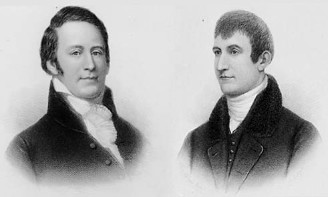
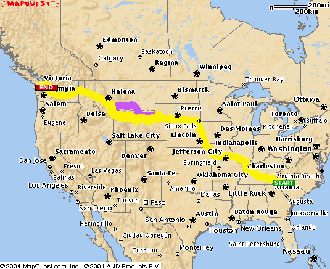
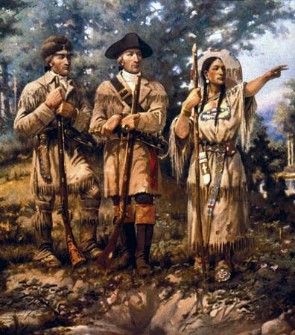
Meriwether Lewis and William ClarkBy: Ruchi Patel Meriwether Lewis and William Clark otherwise known as Lewis and Clark were explorers of the Louisiana Purchase. From 1804 to 1806 these two courageous former soldiers left to the west region of the New World (America) seeking a route to the Pacific Ocean (the Northwest Passage). Lewis and Clark traveled more than 8000 miles while also leading a small crew of strong men also well-known as the Corps of Discovery. They worked together while crossing the Rocky Mountains and eventually reached the Pacific Ocean. These two men and their group also met many friendly Native Americans along the way who helped them on their journey. Sacagawea was one of the famous Indian Americans who guided the group. However, unfortunately, all of them weren’t as nice and helpful as others.
Some natives attacked the Corps of Discovery. There were also many other great dangers ahead that Lewis and Clark came across. After these two years, they both came back to the known places of the United States. On their journey, they didn’t uncover the Northwest Passage but their expedition was nothing close to disappointment. They had proved to everyone that what they thought was impossible was rather the opposite. Lewis and Clark had also showed that even if it was tough and difficult it was achievable.
Their story all started when Thomas Jefferson became president in 1801. He was determined to send explorers across America to uncover new objects and passageways in the west. Two years after he was in presidency, he sent a confidential letter to the congress asking for two thousand five hundred dollars to support his idea of a journey to the Pacific Ocean. After a few months, the Congress responded stating that they will provide funds for the journey to the western part of the U.S. President Jefferson had three main purposes. He wanted to start trade with the Indian Americans from the western area. He hoped to locate a water path to the Pacific Ocean and also see how things were different and alike from the East. After the Congress’s approval and funding, he chose his personal secretary member, Meriwether Lewis, a former military soldier, to go on the expedition. Jefferson also chose William Clark who was previously a soldier. Lewis and Clark were made head of the Journey.
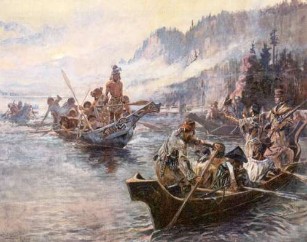
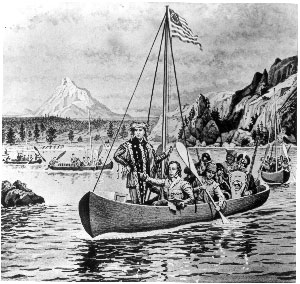
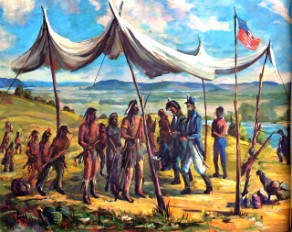
While on the trip, the Corps of Discovery explored the Missouri River. While travelling up the river, the group had a hard time. The party’s three boats were mostly moved by manpower and the wind. They couldn’t rest their effort or the boats would begin floating backwards. Since it was summer, the scorching heat made their trip up the north of the river all the more difficult. Even through these conditions, by July 21, they had gone about 642 miles up the river. After a few weeks of travelling, Lewis and Clark ended up in the High Plains. After a short time in the plains, the crew encountered The Teton Sioux, an Indian tribe that even most other tribes feared. They were known for charging the Europeans and even their fellow tribes very high tolls to get across their territory. The Corps approached them and they were asked to pay them. Lewis and Clark paid with gifts and riches. When the Sioux also asked them for one of their native boats, Lewis and Clark refused. The tribe said that without the boat, they would not let the Corps of Discovery pass. The captains raised their weapons and only then, did they get past. In his journal, Lewis referred to them as “the pirates of the Missouri”.
For the Corps of Discovery, the whole mission ahead of them would get harder and harder than easier. In front of them was the Bitterroot Range, a stretch of the Rockies that separates modern day Idaho and Montana. Lewis and Clark wanted to reach the Columbia River and nearby was the Salmon River which led straight to it. After long weeks of traveling they finally reached the Pacific Coast After traveling about 4118 miles, the Corps built a winter fort. The crew, however, did not like the fort for two main reasons: The local Native Americans and the rainy weather. Lewis and Clark called the Indians thieves because of their years of trading and their smart deals. By late March, the crew was tired of the pacific coast and they were ready to plan the returning trip. By July they were almost near the Continental Divide. Back at the East, many Americans had thought that the Corps of discovery hadn’t made it. So when the exhausted travelers rode their boats down to St. Louis everyone was surprised and cheered. Their journey was just the beginning of many others to the west end!
Bibliography
Books
Kozar, Richard. "Chapters 1,2,and 3." Meriwether Lewis and William Clark Explorers of the Louisiana Purchase. 7-48. Print.
Bursell, Susan. "The Dream of Discovery and West to the Pacific." The Lewis and Clark Expedition. Mankato, Minn.: Bridgestone, 2002. 4-20. Print.
Websites
"Lewis and Clark's Historic Trail." Lewis and Clark's Historic Trail. Web. 30 Apr. 2010. http://www.lewisclark.net/.
"Discovering Lewis & Clark : Missouri River Scenes." Discovering Lewis & Clark : Home. Ed. Gary E. Moulton. Web. 29 Apr. 2010. http://lewis-clark.org/content/content-channel.asp?ChannelID=158. |
      |
Make a Free Website with Yola.
